RSS Feeds
  • No categories

Common Movement Dysfunctions

Posted by Thomas in Athletic Development, Injury Prevention, Resources | 4 comments

When evaluating movement using the 5-SITE integrity approach we commonly look for these movement  dysfunctions. Have a look through the various dyfunctions. I’ll update this post shortly with pictures of each dysfunction. I will also discribe how we scale these dysfunctions.

Foot and Ankle

Pes Planus

During the movement screen, we examine your foot to determine if the movement in your foot is optimal.  Specifically, the most common type of dysfunction in the foot that can lead to energy leaks is a pes planus.  Pes planus, or flat feet, is a very common finding among the general population.  When dynamically tested, individuals with pes planus will exhibit turning out of their feet and a collapse of the main arch of their feet (longitudinal arch).  This finding can also contribute to the other findings within the movement screen.

Limited Dorsiflexion

This finding represents a limitation ankle joint’s range of motion.  Specifically, it means that the top of the foot does not get as close to the shin as it should while being loaded such as while performing a squat.   What this means is that those who have limited dorsiflexion in their ankle are likely make up for this lack of range by compensating somewhere else to get to the same depth of a squat.  Often times, people will use their backs predisposing them to injury due to overuse/misuse, or they may simply not be able to achieve the same range of movement while performing the specific movement in question.

External Foot Flare

This finding represents turning out of the foot while under dynamic load.  This may be a result of poor foot posture stemming from over pronation or pes planus. 

Knee

Dynamic Valgus

This finding represents the knees inability to maintain its dynamic integrity (position during movement) while under load.  What we see is a collapsing medially (inward) of the involved knee representing poor control, weakness of the hip musculature, and/or poor foundational support from poorly controlled foot motion.

Sagittal Control

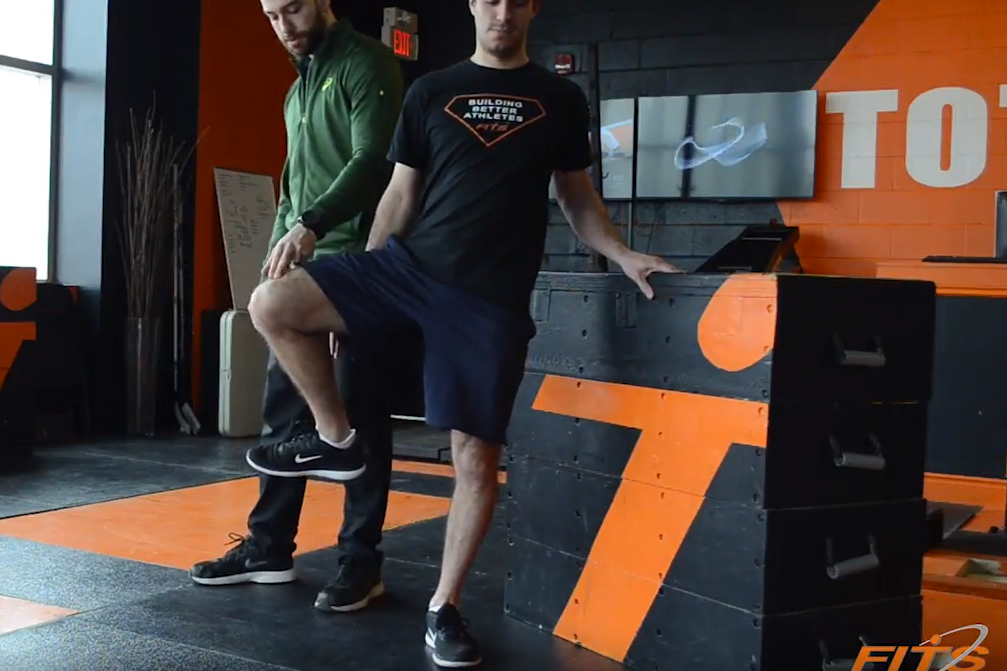
This concept represents the importance of muscular control of one’s knee while under dynamic load.  What we see at times is a “shimmy” in the knee while the patient attempts to control knee movements such as a single leg squat.  This can represent poor muscular control and coordination  of the knee, hip and foot musculature.


Lumbopelvis and Hip

Where your spine and hip attaches to your pelvis 

Hip Hinge

This finding represents the correct way to perform a squat and generally to “bend at the hips”.  A good “bend” is initiated at the hip and not the low back where, as the name implies, you literally hinge your movement at your hips.  Those who cannot perform this movement and tend to favour bending through their back are predisposed to developing low back pain and poor performance, because instead of using their legs they use their spines to lift. Correcting this movement yields tremendous improvements for patients or athletes in terms of low back pain and performance.

Hip Mobility

This finding represents your hip range of motion in flexion, extension, internal and external rotation, and all combined movements of the aforementioned ranges. As a car needs lubricant to function properly you need hip mobility to keep your hips, low back and knees functioning properly. Tightness in the hips lead to stress and strain into joints that can create many musculoskeletal conditions that overtime can easily lead to arthritis in the previously mentioned sites. Sitting and our normal activities of daily living reduce our hip mobility. Therefore to be able to achieve your full athletic potential combined with staying injury proof requires you to constantly maintain proper hip mobility.

Hip Strength Quality

This finding examines the strength and ease of movement the athlete or patient displays during the various movements assessed. It is seen during low load testing as the depth the individual is able to achieve for example during the squat, lunge, and single leg squats. During high load conditions it is the individuals’ ability to absorb forces through the muscular system and to develop power (rate of force development)

Spine Buckling

This finding represents the spines inability to handle load.  What this means is that the spine is unable to support itself due to poor core musculature support.  Much like a mast on a ship, the spine requires guide wires to tightly hold the mast upright otherwise it will crack and the ship will lose its sails.  Similarly, without appropriate conditioning of the core muscles around the spine and pelvis, the body’s mast (your spine) will buckle causing you to lose the wind in your sails and the spring in your step.  Simple movement such as bending forward becomes painful.  This finding tends to become apparent while perform any bending movement. 

Sandwich Movement

This finding represents when a person has does not display a hip hinge, has poor mobility through their hips, and favours using their back while perform a specific movement.  Essentially, what is seen is the torso and legs form the “bread” of the sandwich while the space in between becomes the filling.  A well conditioned pattern finds that the torso is in a neutral position with the chest up; while a “sandwich pattern” finds the chest bent into the legs and facing down – they look like a sandwich. In this position the low back is doing the lifting not the legs. Adopting this pattern negates the most powerful muscles in your body in favour of the back which predisposed the individual to developing chronic low back pain. Correcting this movement pattern and developing a proper hip hinge would be tremendously beneficial. In fact, most people with low back pain display this dysfunction that once corrected no longer have back pain.

Pelvic Control

Much like the above three findings, pelvic control reflects the patient’s ability to dynamically (through movement) maintain a stable pelvis (foundation) while performing various movements.  Dysfunctions are seen as aberrant movements of the pelvis; shifting, tilting, hiking and rotating. These dysfunctions occur largely because of an inability to maintain neutral spine control and are linked to the findings throughout the other anatomical sites, such as your ankle and foot. The impact of poor pelvic control relates to its’ central position in the body. Your pelvis is the transfer point for forces generated in your hips (the main power centre in the body) combined with force contributions from other areas of the body. Pelvic control is like the drive train of a car which functions to transfer power developed from the engine to the wheels. Many problems throughout the body will occur with poor pelvic control such as low back pain, hip problems, knee problems, and even shoulder problems.

Something to Think About:

Regardless of whether you are an athlete or not, pelvic control is essential. If you are an athlete the demands for pelvic control are much higher and are reflective of the demands of your sport. For example it well known that hip and leg contribution to pitching velocity and tennis serve velocity is over 50 percent. This is only possible through pelvic control, or “THE CORE”. Many athletes that fail to develop the core suffer injuries by trying to make up the power elsewhere, such as the elbow and shoulder for both pitchers and tennis players.

Scapulo-thoracic Humeral

Where your arms attach to your spine

Thoracic Collapse

This is a secondary finding often times associated with sandwich movement.  This finding indicates that the patient is not hinging from the hips resulting in a back dominant initiation of movement resulting in thoracic or mid back collapse.  Essentially, the mid-back often times follows the lead of the low back; if the low back is poorly supported, then the same will be seen in the mid-back.

Thoracic Rigidity/Hyperkyphosis

This finding is the opposite of the thoracic collapse.  It represents the inability of the patient to maintain a “chest up” position while under load and undergoing specific movements, irrespective of the stability of the low back.  In chronic situations, this finding can contribute to thoracic outlet syndrome, neck pain, and headaches.

Scapular Winging

This finding represents poor posture of your should blades (aka scapulae).  This finding indicates that you are chest dominant in your posture with likely tight, forward rolled shoulders and weak mid-back muscles.  This can predispose patients to developing chronic rotator cuff tendons, mid-back, shoulder, and neck pain.

Internal GH Rotation

Internal glenohumeral rotation represents a finding that is often associated with hyperkyphosis and scapular winging.  This can also predispose the patient to chronic rotator cuff injuries leading to pain and poor function while attempting to participate in their chosen activity or job.

Cranio-Cervical Junction

Where your neck meets your head

Anterior Head Carriage

This represents the general finding found in almost all people to some degree or another.  It’s what I call the modern cave man position in which our head juts forward in front of our bodies when we primarily sit in a poor position in front of the computer, read or slouch. This finding can represent poor muscular control of the deep muscles of your neck and may lead to chronic neck and jaw pain as well as headaches due to hyperactive posterior neck musculature.

Lateral Shift

Lateral shift of your head on your shoulders may represent a muscle imbalance present at your shoulder, neck, or upper back.  It may also represent a favoured motor pattern that if not corrected can lead to over stressing specific structures and tissue, resulting in breakdown and injury.

Rotation

Rotation is very similar to the finding of lateral shift and is often found in conjunction with it. Rotation may also represent a favoured motor pattern that can indicate the presence of weak and tight neck muscles.


Related posts:

  1. Assessing the Single Leg Squat. How you move determines your injury risk and your performance....
  2. Movement Classification System At FITS we’ve developed a movement classification system we use...
  3. 5 Qualities to develop a great & safe Alpine Racer What does it take to be great? There are many...
  4. THE CORE Part Four – Classification of Trunk Exercises   I’m sure you’re eager to discover specific exercises to...
  5. The Evolution of Dryland Training What is the purpose of dry land? Does it really...

Related posts brought to you by Yet Another Related Posts Plugin.


4 comments

  1. pes planus says:

    [...] entire sole of the foot coming into complete or near-complete contact with the ground. In some …Common Movement Dysfunctions | FITS TORONTOWhen evaluating movement using the 5-SITE integrity approach we commonly look for these movement [...]

  2. I found your blog on facebook groups. I just added you to my MSN News Reader. Keep up the good work buddy! Look forward to reading more from you in the future.

  3. Solid post full of useful tips! My site is fairly new and I am having a baffling time getting my readers to leave comments. They are coming to the web site but I have the feeling that “nobody wants to be first”.

  4. Wilmington says:

    Well, I don’t know if that’s going to work for me, but definitely worked for you! :) Excellent post!


Leave a comment

WordPress Blog
mugen 2d fighting games
WordPress Themes themeforest